Count the voices first. Our reading: for one host, the Focusrite Vocaster One fits the job: one mic input, a 70 dB gain range, and phone and loopback connections. For two hosts at one table, you need two mic inputs: the Scarlett 2i2 4th Gen or the MOTU M2.


Quick Comparison
| Model | Mic inputs | Loopback (maker page) | Extras listed | Best for |
|---|---|---|---|---|
| Focusrite Vocaster One | 1 | Two sets of stereo | Phone input via TRRS cable, phantom control | Solo host with call-in guests |
| Scarlett 2i2 4th Gen | 2 | Yes (4 x 2 including loopback) | 1 headphone output | Two hosts, one computer |
| MOTU M2 | 2 combo | Driver loopback | MIDI in and out, 1 headphone | Two hosts plus per-input 48 V |
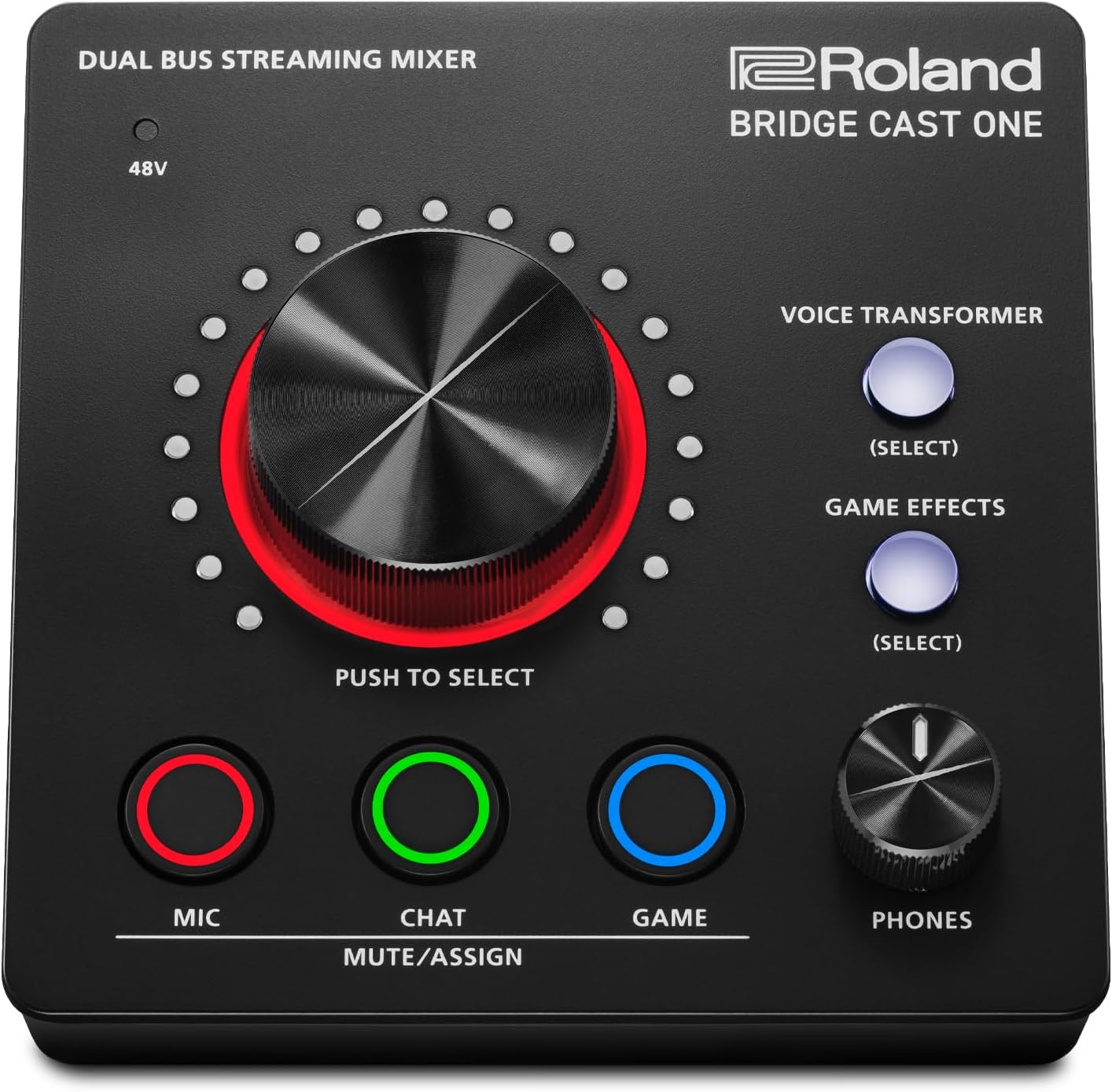
| Roland BRIDGE CAST ONE | 1 XLR plus headset jack | Not mentioned | Two buses: STREAM MIX, PERSONAL MIX | Live streams |
Source: Focusrite, MOTU and Roland product pages, checked November 2026.
How We Chose
The job: a podcaster on Windows or macOS recording one or two voices into a computer, possibly with a remote guest. We looked at the number of mic inputs, phantom power for condensers, loopback, and headphone outputs. We research and compare; we do not run our own product trials. The Desk & Bench Score on a card reflects verified buyer ratings, converted with 6.5 + (stars minus 3.0) x 1.5 and kept between 5.0 and 9.5 (details). We could not open MAONO’s product pages, so we left its E2 Gen2 mixer out.
Our picks
Focusrite Vocaster One
Focusrite lists “over 70dB of gain”, phantom power control, USB-C at 900 mA, and two sets of stereo loopback for playing computer audio into the show. Its phone input needs a 3.5 mm TRRS cable, not included, and is mono. The page lists one mic input and states no sample rate.
Best for: one host who takes calls. Avoid if: a co-host sits beside you; there is one mic input.
Focusrite Scarlett 2i2 4th Gen
Focusrite lists two mic preamps, a 69 dB gain range, loopback, and one headphone output. Our reading: two hosts then share that single headphone output.
Best for: two hosts and two XLR mics. Avoid if: each person needs their own headphone volume.
MOTU M2
MOTU lists two combo jacks with independent gain, 48 V and monitor switch per input, plus driver loopback for streaming and podcasting. It also has MIDI in and out, one headphone output, and bus power. MOTU’s specs give Windows 11 23H2 or later and macOS 12 or later; its overview page says Windows 10 or higher and macOS 10.11 or higher.
Best for: a duo mixing a condenser and a dynamic mic. Our reading: the per-input 48 V switch makes that possible. Avoid if: you are on Windows 10; MOTU’s specs text mentions Windows 10 and 11 drivers, but its requirements line says Windows 11 23H2 or later.
Roland BRIDGE CAST ONE
Roland lists one XLR mic jack with 48 V phantom power (6 mA maximum), a separate headset jack, two buses (STREAM MIX and PERSONAL MIX), and 900 mA USB-C bus power. Loopback is not mentioned on its page. It supports Windows 10 and 11 and macOS 12 or later.
Best for: a solo host who streams video. Avoid if: you need two XLR mics.
Cost of Ownership
Each host needs an XLR mic, a cable, and headphones. Shure says dynamic mics naturally mask room noise, while condensers are more sensitive, and that its KSM condensers require phantom power; Audient says large-diaphragm condensers need 48 V to work properly. Focusrite’s Scarlett line carries a three-year warranty on its page; MOTU’s M2 specs page lists a two-year warranty; Roland’s term is not stated on the pages we read.
Compatibility
Focusrite lists Windows on Intel, AMD and Arm64 and macOS on Apple Silicon and Intel for the Vocaster One. Roland lists sample rates of 44.1, 48 and 96 kHz on Windows and 48 kHz on macOS. For two mics on one computer, see two mics for a podcast, and connecting an XLR mic to a PC.
FAQ
Do I need an interface for podcasting?
For one voice, a USB mic can do it; see USB mic vs audio interface.
What is phantom power?
The 48 V some condenser mics need from the interface; see what is phantom power.
Where are more models?
See audio interfaces.
Changelog: November 2026: first published.